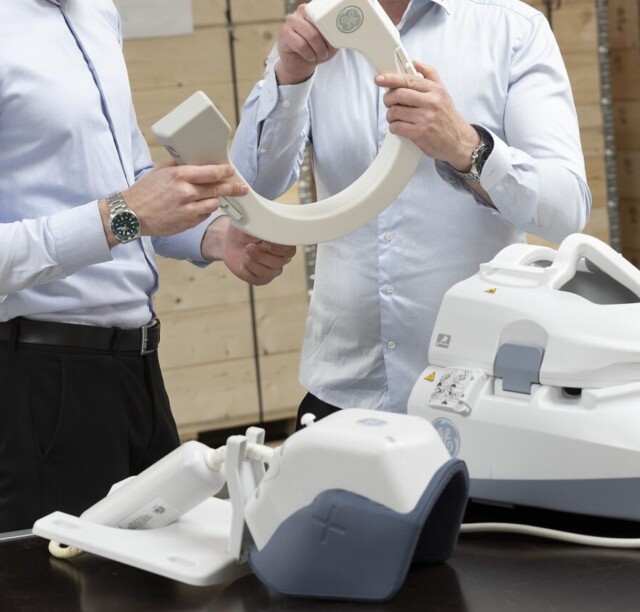

MRI coils are among the most important components in any MRI system. They directly impact image quality, patient throughput, and clinical performance. However, when a coil becomes damaged, worn, or fails completely, many healthcare providers discover that finding a compatible replacement is not always straightforward.
At Scandinavian Medical Solutions, we help hospitals, imaging centers, and service organizations source MRI coils for a wide range of systems from Siemens, GE Healthcare, Philips, and other leading manufacturers. One of the most common challenges we encounter is coil compatibility and in particular, connector compatibility.
What Is an MRI Coil?
An MRI coil is a specialized antenna used to transmit and receive radiofrequency (RF) signals during an MRI examination. Different coils are designed for different anatomical regions, such as:
- Head coils
- Spine coils
- Knee coils
- Shoulder coils
- Breast coils
- Cardiac coils
- Flex coils
- Body coils
The right coil can significantly improve image quality and diagnostic confidence.
Why Coil Compatibility Matters
Many MRI users assume that if a coil fits physically onto the scanner table, it will work with their system. Unfortunately, this is not always the case.
MRI coil compatibility depends on several factors:
- MRI manufacturer
- MRI system model
- Connector type
- Interface cable requirements
Even coils from the same manufacturer may not be compatible across different MRI platforms.
For example, a Siemens coil designed for one MRI system may require a different connector configuration than a similar-looking coil from another Siemens platform.
Connector Types: The Most Important Check Before Purchasing
When sourcing a replacement MRI coil, the connector type should always be verified before purchase.
The connector serves as the communication link between the coil and the MRI system. If the connector does not match the scanner's interface, the coil may not function correctly—or may not be recognized at all.
Before purchasing a replacement coil, we recommend checking:
- Coil part number
- Connector style
- Existing interface cables
- MRI system model
Providing photographs of both the coil connector and scanner connection point can often help confirm compatibility.
When an Interface Coil Cable Is Required
In some cases, a coil may be technically compatible with an MRI system but require an interface cable or adapter cable.
These interface cables allow communication between different coil generations or connector configurations.
Without the correct interface cable:
- The MRI system may not recognize the coil
- Coil channels may not function properly
- Image quality may be compromised
- System errors may occur during examination setup
Our technical team can help identify whether an interface cable is required as part of the replacement process.
Common Reasons for MRI Coil Replacement
MRI coils experience significant daily use and are often among the most frequently handled components in the imaging suite.
Common replacement reasons include:
- Failed elements
- Poor signal-to-noise ratio
- Cable damage
- Connector damage and broken pins
- Broken housings
- Cosmetic wear
- Failed QA testing
- Fluid ingress
While some cosmetic wear does not affect performance, excessive physical damage can eventually impact reliability and patient confidence.
Reduce Costs with MRI Coil Exchange Programs
Purchasing a replacement coil does not always mean paying full market price.
At Scandinavian Medical Solutions, we offer exchange solutions on many MRI coil models.
This means customers can return their defective, damaged, or cosmetically worn coil and receive a reduced purchase price on a replacement unit.
Benefits include:
- Lower acquisition costs
- Faster replacement process
- Reduced equipment downtime
- Sustainable reuse and refurbishment of components
Even coils with cosmetic damage, failed elements, or connector issues may still have exchange value.
We encourage customers to provide photographs and part numbers so our team can evaluate exchange opportunities before purchase.
Information to Gather Before Requesting a Quote
To ensure compatibility and identify the most cost-effective solution, we recommend providing:
- MRI manufacturer
- MRI model
- Coil part number
- Coil serial number (if available)
- Photos of the connector
- Photos of any damage
- Information about existing interface cables
The more information available, the faster compatibility can be verified.
Need Help Finding the Right MRI Coil?
Finding a compatible MRI coil requires more than simply matching a part number. Connector types, interface cable requirements, and system compatibility all play a critical role in ensuring successful installation and performance.
At Scandinavian Medical Solutions, we help healthcare providers worldwide identify compatible replacement coils, verify connector configurations, and reduce costs through exchange programs whenever possible.
If you are looking for a replacement MRI coil, contact our team with your system details and coil information, and we will help identify the most suitable solution.